
Searching Stewart County Criminal Dockets
Start with Ethan Gray, the Circuit/General Sessions Court Clerk, for an adult Circuit or General Sessions case. His office is at 225 Donelson Parkway, Second Floor, Dover, with weekday hours from 8:00 a.m. to 4:30 p.m. and a noon-to-1:00 p.m. closure. Call (931) 232-7042 or (931) 232-8474. A name, approximate year, court, charge type, and docket number can narrow the request.
No verified public Stewart County trial-search screen exists. The useful channels are a phone inquiry, an in-person clerk request, mail to the confirmed office address, or a county public-records request for inspection, electronic delivery, pickup, or USPS delivery. Ask for an existing docket entry or docket sheet, not a new report. The county form distinguishes free inspection from copying, for which an estimate, staff time, postage, or delivery charge may apply. It also gives the office up to seven business days to respond under the stated county procedure. A response may ask for more detail, schedule inspection, quote an estimate, or cite a lawful access limit.
Mail should identify Stewart County Circuit or General Sessions Court and describe the record with enough detail to locate it. Gray's published mailing address is PO Box 67, Dover, TN 37058, but callers should confirm the right box and payment method before sending a copy request. Fax service is listed at (931) 232-3115. A request for certification should say so because a plain informational copy and a certified court copy are different products, and no current local certification fee was verified.
- Identify Circuit, General Sessions, juvenile, or a city court from the citation or prior filing.
- Gather the docket number, name, approximate filing year, and exact record sought.
- Call or visit the responsible clerk and ask whether a public docket sheet can be inspected.
- Use the county request form when a copy or a more detailed search is needed.
- Confirm the next setting and request certification separately if an official copy is required.
Stewart Criminal Courts Compared
The first court is tied to the case stage. General Sessions handles preliminary felony hearings and may try misdemeanors when the required jury rights are waived. A felony trial ordinarily moves through Circuit Court because Stewart County has no separately listed Criminal Court. Both routes begin at Gray's combined clerk office, but that shared counter does not make the two dockets identical.
| Route | Typical role | Best request |
|---|---|---|
| General Sessions | Preliminary felony work and authorized misdemeanors | Current setting, warrant routing, judgment, or docket entry |
| Circuit Court | Felony trial and general criminal jurisdiction | Trial docket, orders, disposition, or appeal identifier |
| Juvenile route | Youth matters under separate access limits | Ask the juvenile contact what lawful access applies |
Juvenile questions may also route through the Youth Service Officer at 112 Natcor Drive, (931) 232-6322. Public access cannot be assumed.
Inside a Stewart County Criminal Docket
A docket is the court's event index, not the whole file. It can identify the matter, record filings, list settings, and show orders or a disposition. An attachment may still be sealed or redacted even when its docket entry is public. Stewart sources did not establish a public local case-number format, so use the number exactly as the clerk or court document prints it.
| Docket number | The stable identifier, shown as the number printed by the court. |
|---|---|
| Charge | The alleged offense and related filing information, subject to later amendment. |
| Settings | Docket call, arraignment, motion, plea, probation, or trial events. |
| Filings and orders | Motions, clerk-filed records, judgments, and court orders. |
| Disposition | The recorded outcome; it is distinct from an arrest or booking entry. |
Stewart Criminal Docket Terms
The 23rd Judicial District rules use event labels that describe why a case is on a calendar. They do not all mean trial.
- Docket call
- A scheduled review or call of cases on the court's list.
- Arraignment
- A stage when the charge is addressed and a plea may be entered.
- Motion day
- A setting for requests that ask the judge to rule before final disposition.
- Plea day
- A calendar devoted to plea proceedings.
- Disposition
- The recorded resolution, such as a judgment or dismissal.
The district covers Stewart plus Cheatham, Dickson, Houston, and Humphreys Counties. Rotating sessions make a current clerk confirmation more reliable than an old schedule. Archived local-rule material also lists grand-jury patterns, but those dates do not form a complete or current criminal calendar. Ask for the active docket call, judge, time, and place before travel.
How a Criminal Case Moves
A Stewart County criminal case may begin with a charge and a General Sessions appearance. A felony can proceed from a preliminary hearing toward grand-jury action and Circuit Court. Motions, continuances, pleas, trial events, judgments, and sentencing create separate entries. Not every case follows each step, and a reset is not a dismissal. Likewise, a charge description can change, a motion entry does not reveal how the judge ruled, and a setting may move without resolving the case. Read later entries before drawing a conclusion from an early event.
Docket flow: Filing › Arraignment › Pretrial › Plea or Trial › Disposition › Sentencing
Stewart Criminal Appeals Online
Tennessee Public Case History accepts a case number, case style, party, business, or other search term, but it covers appellate history. The Tennessee opinions search offers county, court, judge, case number, date, name, keyword, and disposition filters.
The official search display below illustrates those appellate filters.
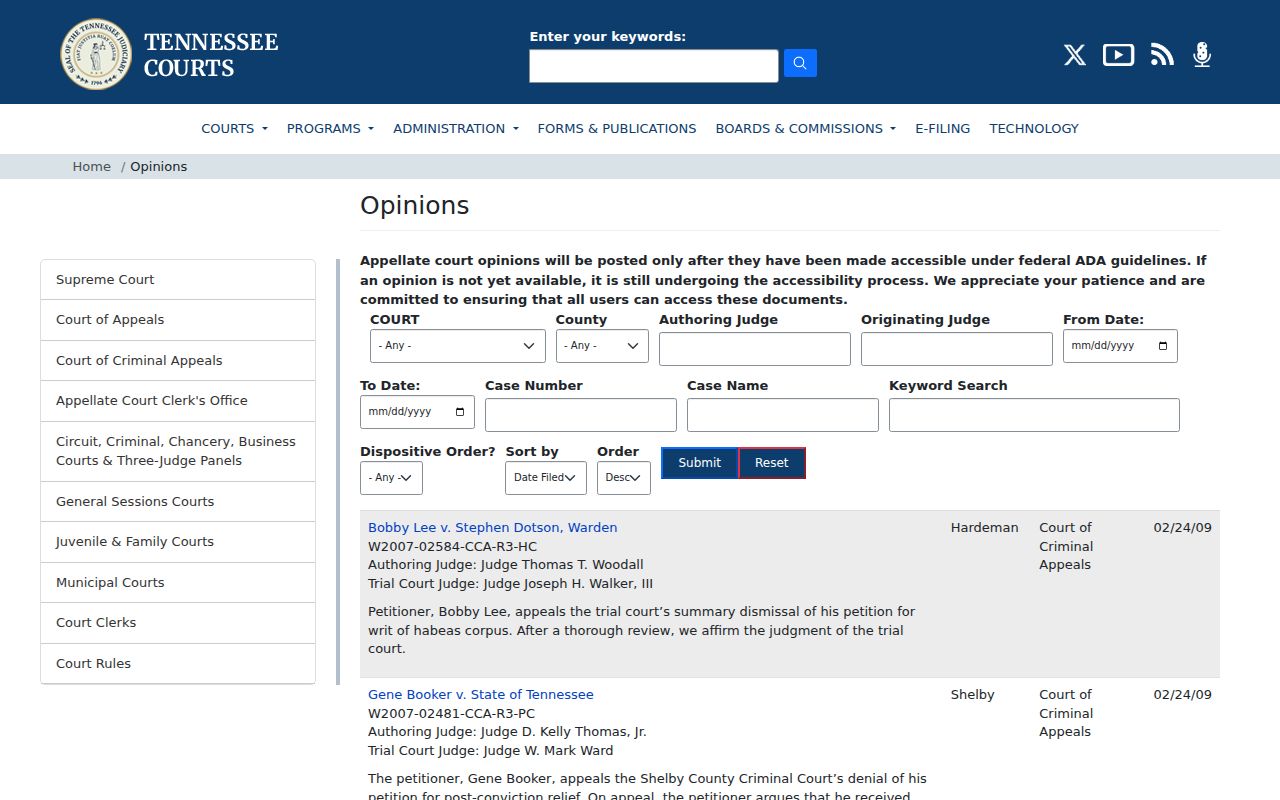
An appellate result can reveal the originating court and trial docket number. Its absence cannot prove that no Stewart County trial case exists.
The official appellate detail layout shows how a public appeal can carry trial-court fields:
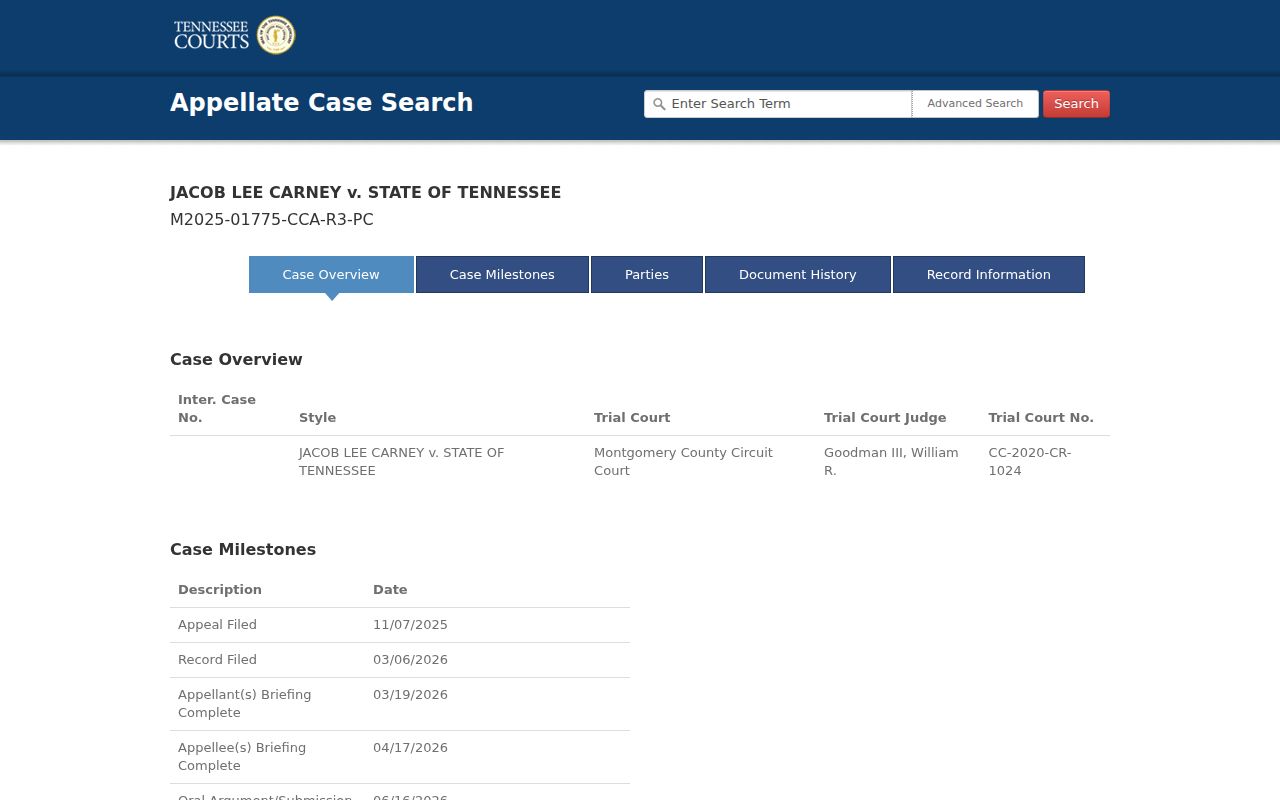
Those fields can bridge a search back to the trial clerk, but the appeal page is not the current county criminal docket.
Courts That Hold Criminal Dockets
Circuit Court is Stewart's general trial court. General Sessions supplies the limited lower-court route. Dover, Cumberland City, and Tennessee Ridge clerks keep their own municipal traffic and ordinance dockets. A city ticket therefore should not be sent to the county clerk merely because the city lies in Stewart County.
Federal cases are separate. Stewart County is assigned to the Nashville Division of the Middle District of Tennessee, where PACER supplies public federal docket access. County staff cannot retrieve that federal record. The caption, issuing court, or case number is the fastest routing clue. Municipal cases also stay with their city clerks: Dover, Cumberland City, and Tennessee Ridge each has its own route for ordinance or traffic matters. A city payment receipt is not a county criminal docket sheet.
Stewart Criminal Expungement Requests
Tennessee's expungement information directs an eligible request back to the court where the matter originated. The docket number matters, and separate forms may be required. Eligibility is case-specific. A missing public result does not itself prove that a record was expunged.
Ask the originating clerk for the case identifier and correct filing route. Do not use Public Case History as a substitute, since it only tracks appellate matters. Some dismissed charges, no-true-bill outcomes, no-charge arrests, not-guilty results, or nolle prosequi outcomes may have a distinct official process, but the clerk or a licensed Tennessee attorney should assess the actual record. Never assume a broad request can change or remove a docket entry.
Stewart Docket Portal Limits
Tennessee Case Finder may appear in search results as a system for Circuit Court Clerk offices, but its login warning identifies a restricted government site. It is not a public Stewart County criminal docket search. Do not seek credentials or treat that screen as a failed public lookup.
The distinction explains how a clerk may hold electronic data without offering the same database to the public. Use the clerk, the county records-request channel, or the appellate tools within their stated scope. The state's planned case-management and e-filing work was still in procurement and design in the reviewed reports, not a completed public Stewart portal.
Sealed Dockets and Public Access
Tennessee Supreme Court Rule 34 recognizes public inspection of court records while preserving statutory, court-ordered, sealed, and protected limits. Juvenile confidentiality is a distinct lane. Rule 114 closes specified dependent and neglect proceedings, and other youth records may require party status or another legal basis. Internal case-management material, judicial deliberative work, confidential documents, and data subject to redaction are also not ordinary public docket content.
An online absence can mean many things. The matter may be unappealed, filed under a different court, too new for an index, archived, confidential, sealed, expunged, or simply outside the tool being searched. Ask the Stewart County clerk to state whether the office holds a responsive public record. If access is denied or delayed, the county response form may cite insufficient detail, no responsive record, legal prohibition, or impracticability of review and redaction. Those responses are process results, not case dispositions.
The official Rule 34 page presents the governing public-access rule and its limits:
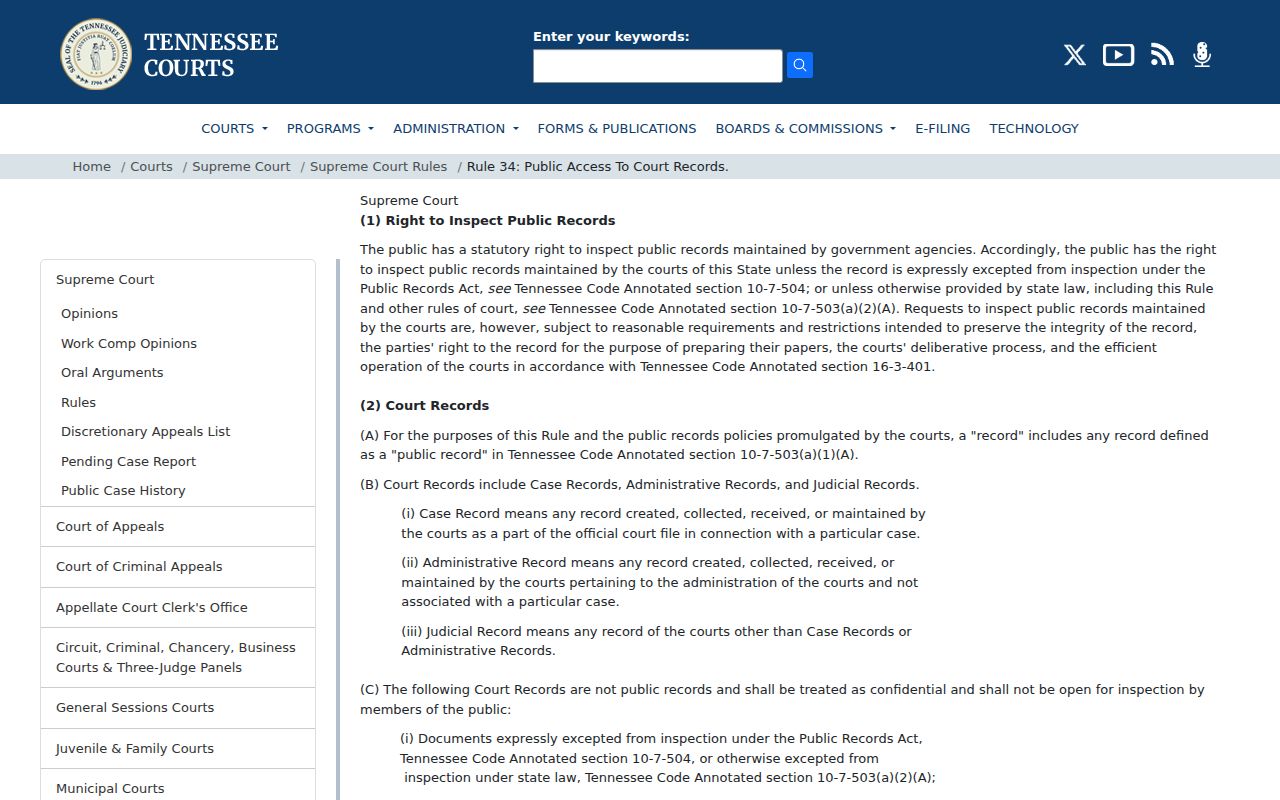
The rule supports inspection while leaving sealed, confidential, and protected criminal material outside ordinary public access.
Access boundary: A visible entry does not make every filed document public.
Tennessee Code § 10-7-503 supports access to existing public records, while § 10-7-504 and court rules preserve exceptions.
Confirm a denial, redaction, or sealed status with the clerk that holds the original record.